
Sweden might not be known for being among the top World Cup teams throughout history. But with a final in 1958 at home as well as a semi-final in 1994 in the USA , Sweden has actually had a couple of decent runs at the World Cup. Another metric is participation rate. Sweden has made it to the World Cup 13 out of 23 occasions.
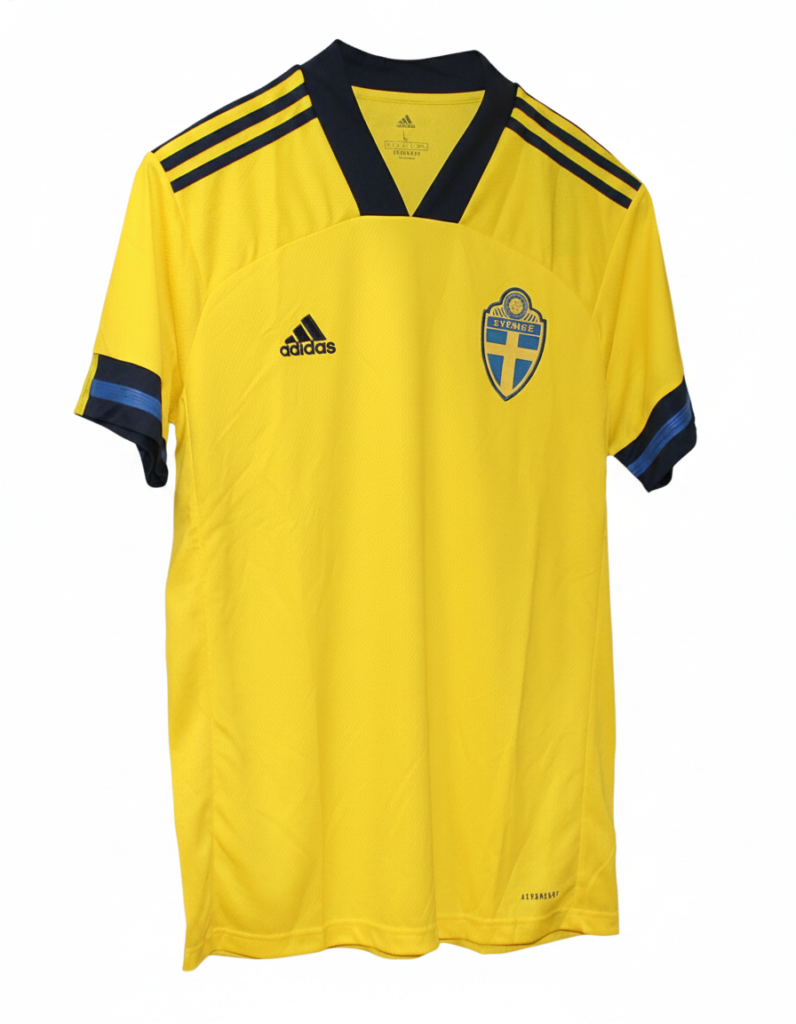
The template for the Sweden home jersey is a very simple one. Yellow with blue contrast. The reverse of the flag which is predominantly blue but with a yellow cross. In the iteration below from the EUROs 2020 the blue has been exchanged for navy. From time to time the athletic brands try to lighten things up a bit so they change a few details, then they revert to mean on the following launch.
The Yellow Wall Returns: Sweden’s World Cup Resurrection
After the heartbreak of missing Qatar 2022, the Blågult (The Blue and Yellow) aren’t just back—they are a warning. Sweden has a strange, almost supernatural relationship with the World Cup. They don’t just participate; they haunt the dreams of bigger nations.
As they head to North America in 2026, they aren’t bringing just a squad; they are bringing a 70-year legacy of being the world’s most dangerous “underdog.”
1. The “1994” Spirit: A North American Sequel
The last time the World Cup was held in the USA, Sweden didn’t just show up—they took over. The image of Thomas Brolin, Martin Dahlin, and Kennet Andersson tearing through defenses is burned into the tournament’s history. That 1994 bronze medal remains the gold standard. Returning to North American soil in 2026 feels like a spiritual homecoming. For the Swedish fans, this isn’t a new tournament; it’s a long-awaited sequel to the greatest summer of their lives.
2. The “Graham Potter” Transformation
Swedish football has spent decades being defined by “Lagerbäck-ism”—a rigid, 4-4-2 defensive block that was as effective as it was boring. But the 2026 version of Sweden is different. Under Graham Potter (the man who essentially learned to coach in the Swedish sub-arctic with Östersund), they’ve traded the shield for a sword. They are playing with a fluidity and tactical arrogance we haven’t seen since the days of Ibrahimović, but without the “Ibra-centric” baggage.
3. The New Monsters: Gyökeres and Isak
If the 90s had Brolin and Dahlin, 2026 has Viktor Gyökeres and Alexander Isak.
- The Chaos Factor: Gyökeres is a physical hurricane—the kind of striker who treats world-class defenders like training cones.
- The Silk: Isak is the scalpel. Together, they represent a Sweden that no longer waits for a 0-0 draw and a lucky header. They are built to embarrass teams on the counter-attack. In the 48-team expanded format of 2026, Sweden is the “Tier 2” team that none of the “Tier 1” giants want to see in their bracket.
4. The World’s Best Traveling Circus
A World Cup without the Swedish fans is a quieter, duller affair. The “Yellow Wall” is a logistical marvel—thousands of fans in IKEA-bright jerseys turning every host city into a giant, sun-drenched festival. In 2026, expect the streets of Monterrey, Houston, and Toronto to be flooded with blue and yellow. They bring a brand of optimism that is infectious, making them the “second team” of almost every neutral fan.
5. The Verdict: The Darkest of Horses
Sweden enters 2026 with nothing to lose and a terrifying amount of talent. They have the historical weight of 1958 (runners-up) and 1994 (third place) behind them, and a fresh, attacking identity in front of them. They aren’t there to make up the numbers. They are there to do what Sweden does best: stay quiet, look unassuming, and then knock a favorite out of the tournament in the Round of 16.