
Mexico a strange case in the world of World Cup football. It has been the host of probably the two most legendary tournaments. 1970 (Brazil) and 1986 (Argentina). It saw primetime Pele and primetime Maradona each win a trophy cementing their roles as legends.
Mexico is also 4th over countries with most participations in the World Cup. 18 times has Mexico made it to the World Cup tied with Italy for fourth most, and trailing only Argentina, Germany, and Brazil.
Quite an achievement. Where Mexico is lagging significantly though is when it comes to results on the field. Never has Mexico made it to the semi-finals, not even once in those 18 attempts thus far.
But playing at home in 2026 could be the differentiator. Maybe this time… will be the most asked question in Mexico prior to the World Cup 2026.
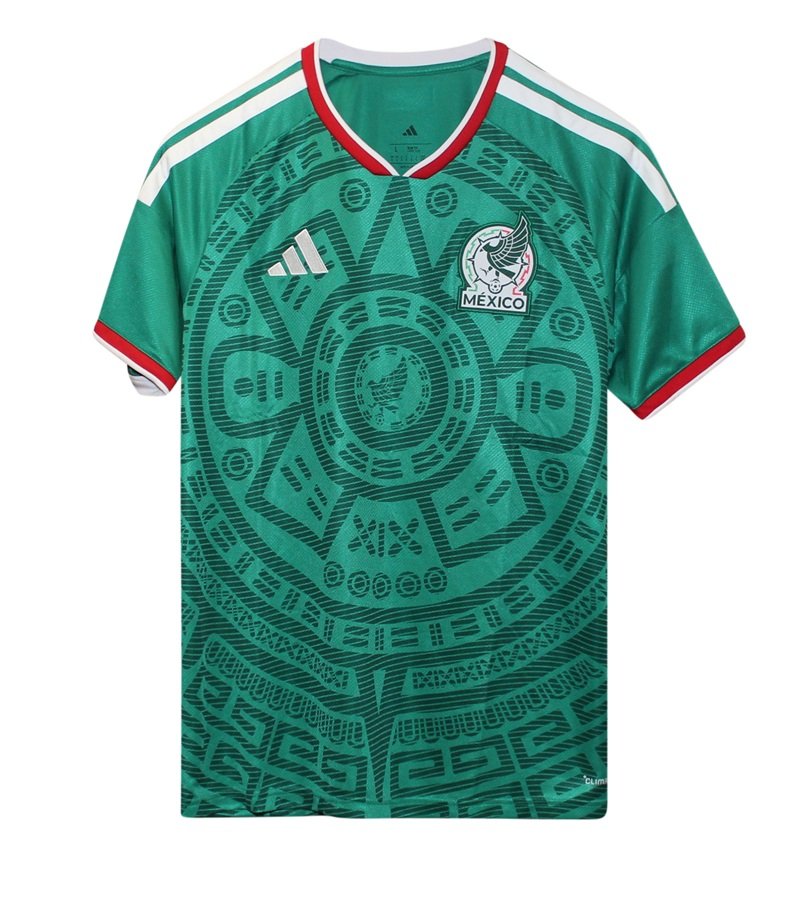
The Serpent’s Resurrection: Mexico’s 2026 Home “Host” Jersey
For years, Mexico experimented with black, pink, and “maroon” kits that felt like identity crises in polyester form. But for 2026, the experiment is over. The “Verde” is back, and it’s more aggressive than ever. This isn’t just a jersey; it’s a suit of armor for a nation that expects the impossible on home soil.
1. The “Obsidian” Green
The base color isn’t just green—it’s “Verde Imperio” (Imperial Green). It’s deep, saturated, and intimidating. It’s designed to look dark and moody under the shadow of the Azteca’s roof, but to explode into a vibrant, grassy neon under the direct Mexican sun. It’s a color that says: “You are in our house now, and the walls are closing in.”
2. Quetzalcoatl’s Skin
The standout feature is the all-over jacquard print that mimics the scales of the Feathered Serpent, Quetzalcoatl.
- The Texture: This isn’t a flat print; the fabric is embossed to give it a reptilian, organic feel.
- The Visual Trick: From a distance, it looks like a solid green kit. As the players move and the light hits the fabric, the “scales” shimmer, making it look like the players are literally shedding their skin and transforming. It’s a brilliant nod to the “Resurrection” of Mexican football.
3. The “3-Stripe” Bloodline
Instead of the usual white or gold, the Three Stripes on the shoulders are a vivid, “Signal Red.” It’s the color of traditional papel picado and, more pointedly, the color of the Aztec sacrifices. When the players stand together for the anthem, those red stripes form a continuous line across the pitch—a visual representation of the “bloodline” that connects the legendary squads of 1970 and 1986 to the modern day.
4. The “Hecho en México” Details
Adidas has leaned into the “Home” narrative with some high-fashion flourishes:
- The Eagle’s Nest: Inside the neck, there’s a stylized graphic of an eagle perched on a cactus, but rendered in a modern, geometric street-art style.
- The “1970-1986-2026” Tag: A small, golden jock tag at the hem lists the three years Mexico has hosted the world, cementing their status as the ultimate guardians of the tournament’s history.
5. The Verdict: God-Mode Activated
This kit is built for the pressure-cooker. It doesn’t try to be “cool” or “lifestyle-friendly”—it tries to be powerful. It’s a kit that demands a quarter-final appearance (at least). It’s the most “Mexican” Mexico kit in twenty years, stripping away the gimmicks and replacing them with ancient, feathered fury.